

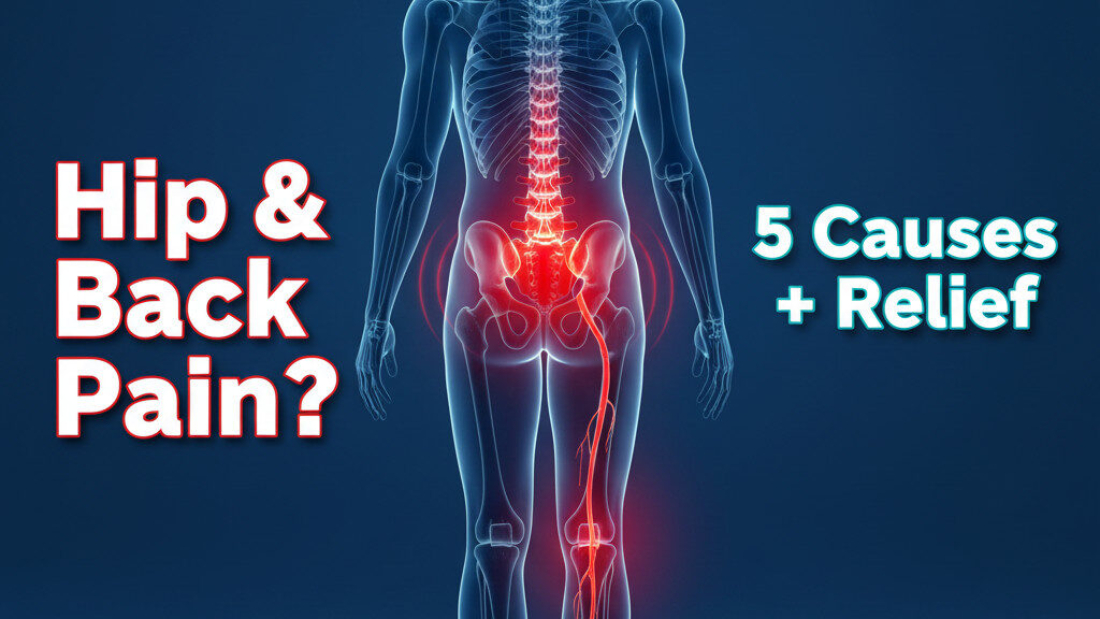
Hip and Lower Back Pain: 5 Common Causes and How to Find Relief
Hey — ever asked yourself: “Why does my hip and lower back pain hurt?”
I remember getting that question from a client a few years ago. He was a 39‑year‑old office worker, complaining about nagging pain in his lower back and right hip — sometimes a dull ache, sometimes a sharp jab if he moved the wrong way. He’d wake up stiff. Sitting at his desk for hours? Pain. Trying to sleep? Pain. Walking the dog? Pain. It drove him mad.
Turns out, it wasn’t one simple thing. It was several overlapping factors. And that’s what I want to walk you through today. Because if you want to find real, lasting relief from hip and lower back pain, you need to know the root cause.
So grab a glass of water, sit back. Let’s dig into the 5 common causes of hip and lower back discomfort — and what you can do about them (with real, actionable steps).
The 5 Usual Suspects Behind Back and Hip Pain
1. Muscle & Ligament Strain (Overuse, Poor Posture — Simple but Common)
Here’s the no‑brainer. Sometimes your lower back and hip hurt because you simply overdid it.
Here’s the no‑brainer. Sometimes your lower back and hip hurt because you simply overdid it. That’s your body sending you a bill for the strain. Whether it’s a sudden twist or hours of slouching, these movements can overstretch ligaments, strain supportive muscles, and irritate tendons—all classic hip pain causes that manifest as that familiar pain in the lower back and hip. Next thing you know, you’re feeling that ache.
This kind of strain often feels dull — maybe a soreness or stiffness, especially when you move or try to stretch. Over time, it might settle into your hip or lower back, or even both. Medical News Today+1
2. Nerve Compression — aka Sciatica
This one’s sneaky. One day you might feel a dull ache; the next — a sharp, burning pain radiating from your lower back, through your butt, down your leg. That’s sciatica.
In most cases, sciatica comes when a disc between your vertebrae bulges or ruptures (herniated disc), pressing on the roots of your sciatic nerve. Harvard Health+2Mayo Clinic+2 Sometimes, it can be due to bone spurs (arthritis), spinal canal narrowing (stenosis), or a vertebra slipping out of place (spondylolisthesis). Stanford Health Care+2University Hospitals+2
Symptoms can include sharp, shooting pain, tingling, numbness, or weakness — usually on one side. It may start in the lower back and travel down through buttock, thigh, calf or even foot. Harvard Health+2Mayo Clinic+2
The thing is — sciatica isn’t always constant. It can flare up, settle down, come back later. That’s why many people don’t even suspect nerve involvement at first.
3. Hip and lower back pain Issues — Arthritis, Sacroiliac joint (SI) Dysfunction, or General Hip‑Joint Wear & Tear
Sometimes the pain doesn’t start in your spine at all. Instead, your hip joint or its nearby structures are the culprit.
Arthritis is the slow-motion breakdown of your joints. When it hits your lower back or hip, it announces itself with a stubborn ache and a rigidity that settles in for good. This is the pain that makes you pivot your whole body instead of twisting, that has you using your arms to push yourself out of a chair. It’s the physical manifestation of your mobility being chipped away, piece by piece. Harvard Health+1
There’s also the sacroiliac (SI) joint. It connects your pelvis to your spine, acting like a shock‑absorber as you stand, walk, or twist. If the SI joint becomes irritated, inflamed, or misaligned, it can trigger pain in the hip, lower back, or groin — often radiating toward buttock or thigh. Healthline+1
4. Degenerative Spine Changes — Discs, Arthritis, Spinal Stenosis
Time isn’t kind to your spinal discs. These natural shock absorbers dry up and shrink, which can cause them to bulge or rupture. And that’s when the real trouble starts: nerve compression. This isn’t just general soreness; it’s the direct, often sharp pain in the lower back and hip that radiates because a nerve is getting pinched. Harvard Health+2Harvard Health+2
Likewise, the vertebrae themselves — or the joint surfaces between them — can develop osteoarthritis. Bone spurs may form. Cartilage wears away. Stanford Health Care+2Harvard Health+2
Often, this kind of degeneration doesn’t manifest overnight. It creeps up slowly. Maybe you feel a bit stiffer each year, maybe movement feels slightly harder, maybe pain flares when you overdo activity.
5. Complex/Overlapping Causes (Yes — Sometimes It’s Not Just One Thing)
Here’s the kicker: often, it’s not a single cause. Spinal degeneration, mild disc bulge, weak hip muscles, poor posture, long hours sitting — all of these can combine and amplify discomfort.
There’s also a less‑talked‑about culprit: deep muscles in and around the butt and hip — for example, the muscle called Piriformis muscle. If it gets irritated or tight (due to overuse, trauma, or poor biomechanics), it can irritate the nearby sciatic nerve or cause referred pain. Some studies show piriformis‑muscle issues in a noticeable fraction of people with low‑back pain. Thejas+1
And sometimes — yes — hip‑joint problems and spinal issues co‑exist, making the pain pattern confusing.
Tired of Achy, Stiff Joints? 5 Science-Backed Ways to Restore Mobility
How to Tell What’s Actually Causing Your Pain
Let’s simplify it. Listen to the quality of the hip and lower back pain. A dull ache is usually a muscle complaining. A sharp, electric shock down your leg is a nerve screaming—that’s classic sciatica. A deep, gnawing stiffness in your hip or groin is the joint itself. And if it’s been a slow, unwelcome companion for years, it’s likely degenerative.
But please, don’t stop there. This is where a professional evaluation is non-negotiable. They have the tools and knowledge to connect the dots you can’t see. Why spend weeks trying a sciatica stretch when the real issue is a worn-out hip joint? An accurate diagnosis is the shortcut to relief.
Real‑World Relief: What Helps — and When to See a Doctor
So you’ve identified your likely culprit. What now? Here’s how I walk people through relief (most of these are things you can start at home).
For muscle/ligament strain: rest, avoid aggravating movements, alternate gentle stretching and light activity, maybe heat or cold compress, focus on posture. Often, that’s enough within a few days to a few weeks. Healthline+1
For nerve compression/sciatica: gentle stretching and mobility exercises aimed at relieving nerve pressure can work wonders. According to Harvard Health Publishing, gentle stretches aimed at improving flexibility and relieving nerve tension are often effective. Harvard Health+1 If pain’s severe or persistent, consider seeking physical therapy.
If you suspect spinal degeneration, disc problems, or mixed causes: Medical consultation is important — especially if pain is chronic, worsens, or impacts daily life. A proper diagnosis helps avoid mis-treatment.
Very important: avoid prolonged bed rest. You’d think lying still helps, but often gentle movement helps more. Sitting too long or staying inactive can make things worse.
Quick Wins & Lifestyle Tweaks for Long-Term Health
Want real, lasting lower back pain relief? Stop overcomplicating it. Master these non-negotiables:
Move more, period. Stiffness is the enemy. Walk. Stretch. Change positions. Strengthen your core and glutes—this is the ultimate armor against the ‘weak hip, weak back’ cycle. Fix your posture; how you sit is either slowly breaking you or building you. Use heat for tightness, ice for sharp pain. And when a minor ache shows up, don’t ignore it. That’s the cheapest warning you’ll ever get. If it lingers, get a professional assessment. It’s the fastest way to understand how to relieve hip and lower back pain for good.
Common Questions (People Also Ask)
Q: Why does my lower back and hip hurt even if I haven’t injured myself?
A: To have pain with no obvious cause. Here’s the thing: your body keeps a running tab. That ‘tab’ is paid with hours of slumped sitting, with skipping stretches, with muscle imbalances you never feel until they scream. The pain isn’t from one event; it’s from your posture and movement patterns, slowly, silently creating a problem.
Q: What’s the difference between hip and lower back pain?
A: Think of it like this: Hip pain tends to live in the front (your groin) or side of your upper leg, and it yells at you when you walk or try to put on socks. Lower back pain camps out in your lower spine and might send shooting messages down your leg. The reason it’s so confusing is that your body isn’t great at pinpointing the source; a hip problem can easily masquerade as back pain, and vice-versa. If you’re asking, ‘why does my lower back and hip hurt’ all at once, this frustrating overlap is usually why.
Q: How to relieve hip and lower back pain at home?
A: For many, relief is found in a consistent routine of gentle movement. Think daily walking, careful stretching, and posture correction. Heat and ice are your first-line tools for comfort. The real game-changer, though, is building strength in your core and hips to take the pressure off.
Q: I feel pain in my lower back and right hip — what could be wrong?
A: It could be a muscle strain, early arthritis, nerve compression (sciatica), or SI‑joint irritation. Sometimes multiple factors overlap. The most reliable way to know is through evaluation (posture assessment, mobility test, maybe imaging). And it’s not rare to have “mixed” pain (hip + back) at once.
When to Consider a Supplement — My Take
If you’re dealing with a nagging hip and lower back pain, managing posture, movement, and strength over time can work wonders. But sometimes, your joints and soft tissues may benefit from additional support, especially if you suspect low‑grade inflammation, wear‑and‑tear, or chronic tension.
That’s where a joint‑support supplement like Joint Genesis might come in handy. I don’t consider it a magic fix — but as a mentor, I’ve seen people combine such supplements with good movement habits, posture hygiene, and stretching routines, and notice reduced stiffness and better mobility over time. If your pain isn’t due to a serious injury (like a major disc herniation) but stems from cumulative stress or mild joint wear, a supplement + lifestyle consistency can be a smart, low-risk addition.
Leave A Comment