

What Causes Stiff Joints as We Age?
Does it hurt to get out of bed? Do your knees and hips feel stiff and sore? This is a common problem, but it is not normal. It is not just a part of getting older. This pain is a sign. Your body is telling you that something is wrong.
Here’s what’s really happening inside you:
That rusty hinge feeling in your mornings? It’s your joints starving for movement. When you’re still sleeping, sitting too long, the natural lubricant that keeps things smooth pulls back like a receding tide. Starting motion again is like trying to work a dry pump. It takes effort and hurts at first until the fluid flows back. This is why your first steps out of bed or up from a chair are the hardest.
Your cartilage isn’t just wearing down – it’s crying out for stimulation. This living tissue actually thrives on motion. The gentle compression of walking, bending, and stretching? That’s what feeds it and helps it maintain itself. The worst thing you can do is stop moving.
And sometimes it’s more serious. When osteoarthritis enters the picture, it’s not just stiffness – it’s inflammation, breakdown, and pain that doesn’t just fade after those first tough minutes. But here’s what matters: even then, movement isn’t the enemy. It’s the medicine. The right kind of activity, managing your weight, working with specialists – this is how you fight back.
Your body is designed for motion. Every step you take, every movement you make, it’s not wearing you down – it’s keeping the machinery oiled and alive. The stiffness is just a warning light on your dashboard. It’s not telling you to park the car – it’s telling you it’s time for maintenance.
Think of your joints like car parts, if you don’t drive them regularly, they seize. But if you do, they stay smoother, longer.
1. Gentle Exercise: The #1 Way to Loosen Stiff Joints
Maybe counterintuitive, but moving actually eases stiffness, a fact backed by science.
- Harvard strongly recommends low-impact cardio + resistance training, saying consistent movement not only lubricates joints but also calms inflammation. Plus, it helps maintain a healthy weight to ease joint load. Harvard Health
- For osteoarthritis in older adults, just 1 to 2 hours a week of moderate activity can help slow symptoms and improve function. Harvard Health
- A Stanford-backed lifestyle review offers a brilliant analogy: synovial fluid is like WD-40 for joints. Without movement, the lubricant dries up, but a stroll, swim, or bike ride redistributes it beautifully. Stanford Center on Longevity
Fix It Now:
- Walk daily. 20-30 minutes.
- Build muscle 2x a week. Protects knees and hips.
Do This:
- Warm up: 5 min walk
- Get strong: 2 sets of half-squats
- Move: 15 min bike or swim
- Stop thinking. Start moving. It works.
2. Mobilization Magic: Proven Ways to Ease Stiff Joints
When joints are tight, manual techniques can help unlock the range of motion.
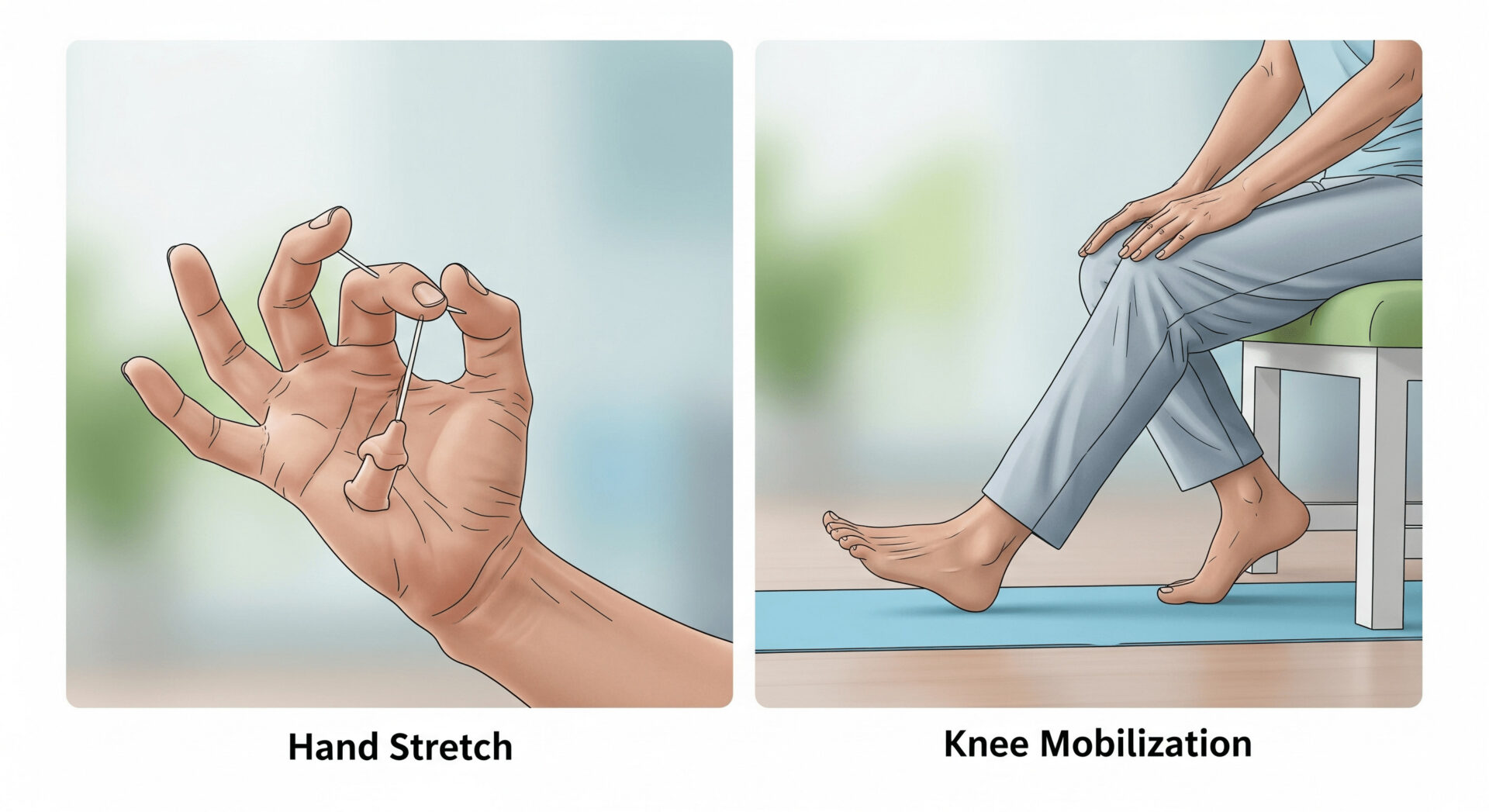
- A 2024 meta-analysis on joint mobilization (knee OA) found significant improvements in pain and function—but not necessarily increased flexion/extensive mobility. Still, this therapy is “the real deal” for reducing discomfort and restoring better movement. ResearchGate
- Similarly, Harvard’s range-of-motion exercises for arthritis illustrate moves you can do gently at home, even on painful days. These include fingertip-to-palm stretches and thumb-to-pinky-saunter motions. Harvard Health
Try this at home:
- Hold your hand flat, bend each finger’s middle joint, touch fingertips to palm, then open, 10 reps per hand.
- Slide thumb across palm toward pinky base, 10 reps.
Short, gentle, and it adds up.
3. Synovial Fluid Secrets: How Your Body Naturally Fights Stiff Joints
Cartilage lubrication is far more impressive than you’d guess, and understanding it is a total game-changer.
Research shows articular cartilage has the lowest friction coefficient in nature, think 0.001 in some cases! It’s thanks to a combo of molecular boundary lubrication and ultra-efficient synovial fluids. arXiv
Even cooler? Synovial fluid isn’t just one thing; it’s a sophisticated lipid blend. Its diversity and synergy are key to keeping your joints running whisper-quiet. arXiv
So, movement + maintenance = the perfect pair.
4. Simple Lifestyle Tweaks to Reduce Stiff Joints and Inflammation
Beyond movement, small lifestyle habits help dampen the root causes of stiffness.
- Sleep well: Restorative sleep helps reset pain sensitivity, crucial when pain heightens stiffness. Stanford Center on Longevity
- Hydrotherapy: weightless relief
Pushed-out with good news: water unbiasedly offloads joints—reducing knee stress by up to 55%, hips by 46%. Activities like swimming are total game-changers for achy knees. The Times - Avoid over-reliance on gadgets: Harvard warns us that foam rollers, kinesiology tape, and TENS offer mixed results for stiffness. Instead, simple knee braces and hydrotherapy came out on top. The Times
Easy wins:
- Aim for 7–8 hours of quality sleep.
- Mind how you eat—reduce inflammatory foods like sugar and processed junk.
- Try swimming or water aerobics twice a week.
5. Do Supplements Really Work for Stiff Joints? Here’s the Truth
Here’s where people search “best supplement for joint stiffness”—but we gotta be honest.
- There’s a ton of interest in supplements (glucosamine, turmeric, MSM, etc.), but the latest reputable guidelines stress exercise and lifestyle as first-line, not pills.
- Still, if someone wants a complement, Joint Genesis – Youthful Joint Mobility & Comfort Formula (see below) is an option, but it should be secondary to foundational moves and habits.
5 Surprisingly Easy Ways to Lubricate Your Joints Naturally (and Feel Young Again)
Your Game-Plan: Restore Mobility Like a Boss
| Step | What to Do |
| 1 | Move daily: walk, swim, bike, strength train. |
| 2 | Try joint mobilization and gentle stretches. |
| 3 | Keep synovial fluid happy—move regularly. |
| 4 | Sleep well, swim in water, and avoid overbeat gadgets. |
| 5 |
Consider Joint Genesis if you want that little bonus. |
Restore mobility, ease achy joints, and reclaim your groove. Trust me—it’s not rocket science, it’s smart science.
FAQs
1. Morning joint stiffness? Here’s the deal.
You know that feeling. You wake up. Everything’s stiff. Hips, knees, fingers, they all creak. Why? You haven’t moved all night. Joint fluid needs motion to work. For most people, it loosens up after a few minutes. But pay attention. If it lasts longer than half an hour? Every single day? That’s your body sending a signal. It could be arthritis setting up shop. Don’t ignore that signal.
2. Does cold weather affect joints? Yes.
It’s not your imagination. Cold, damp days make everything hurt more. Science isn’t 100% sure why. The theory is that air pressure changes make tissues swell. This puts pressure on nerves. The result? A deep, throbbing ache in your knees and hips. Your stiff joints are a living weather forecast. It’s miserable, but it’s real.
3. Is it always arthritis? No.
Sometimes a stiff joint is just a stiff joint. You slept wrong. You overdid it in the garden. You sat too long at your desk. The problem isn’t the occasional ache. The problem is a constant ache. If you’re always asking, “Why are my joints so stiff and achy?” you need an answer. That answer starts with a doctor’s visit. Don’t assume the worst, but don’t ignore it either.
4. Want to eat your way to less joint pain?
It’s simpler than you think. The goal is to eat foods that calm your body down, not fire it up.
Load up on these:
- Fatty fish like salmon
- Walnuts and almonds
- Blueberries and strawberries
- Green tea instead of soda
These are like little firefighters for the inflammation in your joints.
Now, the stuff to avoid? Sugar. White bread. Packaged snacks. Fast food. This junk is like throwing gasoline on a fire; it makes the swelling and pain so much worse.
What you choose to put on your plate every day is everything. It can either be causing the problem or fixing it. The choice is that simple, and it’s yours.
5. When is it time to actually call a doctor? No sugar-coating.
Let’s be blunt. You should call a doctor when stiffness changes your life. If it’s getting worse, not better, with simple rest… if it lasts for hours… or if it shows up with swelling, redness, or pain that makes you cancel plans—it’s time. Don’t fall into the trap of thinking you’re “just getting old” or that you have to live with it. Getting a real diagnosis is the truest form of self-care. It’s the only way to get a real plan, which might include the best supplement for joint stiffness for your specific needs, targeted exercises, or other treatments. Taking action is how you take your life back.
Give Joint Genesis a Try (If You Want That Extra Boost)
Looking for a little extra support after incorporating all the above? Joint Genesis – Youthful Joint Mobility & Comfort Formula could be your ally in the joint-health journey.
Why it fits:
- Complements your movement and lifestyle routine.
- Designed to support flexibility and comfort—without replacing healthy habits.
Try it and feel the difference—then come back and tell me it was a smart call!
Leave A Comment